
How to optimize irrigation scheduling in Practice
The real cost of poor irrigation is often hidden, because most systems are not as uniform as we assume.
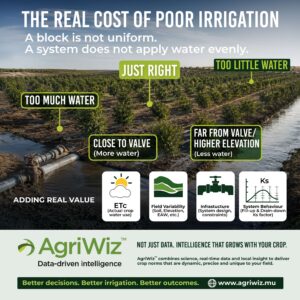
A block does not have one single water requirement, and an irrigation system does not apply water perfectly evenly across the whole field. During every irrigation cycle, the system goes through a fill-up phase at the start and a drain-down phase at the end. This is where a large part of the variability begins.
Areas close to the valve often receive water earlier and for longer. Low-lying sections may continue to drain and apply water after shut-off. Differences in elevation, pressure, pipe layout, soil type, emitter performance, and hydraulic design all add to this variation. The result is simple: some parts of the block receive too much water, while others receive too little.
When one fixed irrigation run time is used for the entire area, you are almost always making a compromise. Part of the area becomes over-irrigated, which can reduce root oxygen, leach nutrients, and waste energy and water. Another part remains under-irrigated, which limits transpiration, photosynthesis, fruit growth, and ultimately yield. In many orchards, this hidden lack of uniformity is one of the biggest reasons why irrigation does not perform as well as expected.
That is why auditing the irrigation system is so important. Before irrigation scheduling can be truly accurate, the system itself must be checked and understood. A proper irrigation audit helps identify the causes of poor uniformity, including pressure differences, blocked or leaking emitters, incorrect pipe sizing, valve limitations, elevation effects, poor flushing, and uneven fill-up and drain-down behavior. Without this process, scheduling decisions are often based on assumption rather than reality.
Improving irrigation uniformity is one of the most effective ways to improve water-use efficiency and crop performance. A better-audited system allows the grower to correct the efficiency of the system to apply water more evenly, reduce compromise, and align irrigation more closely with actual crop demand. In other words, the goal is not simply to irrigate more accurately on paper, but to ensure the system can physically deliver that accuracy in the field per valve.
This is where AgriWiz™ adds real value. AgriWiz™ together with an effective system design and performance does not assume perfect uniformity; it works with real field conditions. Recommendations are based on ETc (actual crop water use), while also taking into account field variability, such as soil differences, elevation, effective available water, and infrastructure constraints. It also considers system behavior, including the effects of fill-up and drain-down. This is controlled by the Ks factor (environmental) factor which is unique for every valve
This means irrigation recommendations are built around how the system actually performs, not how it should perform under ideal conditions.
The key question is this:
Are you scheduling irrigation based on what the crop uses, or based on what the system happens to apply?
Because the more uniform the system, the more accurate the irrigation. And the more accurate the irrigation, the greater the chance of protecting yield, fruit quality, and input efficiency.